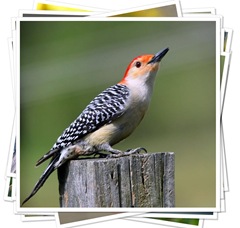
Wings UP!
I’ve finally added a new album in my Picasa Web Albums. You can view all of the latest uploads in “Wings Up”.
Downy Woodpecker (male)

Northern Cardinal (male)
I’ve finally added a new album in my Picasa Web Albums. You can view all of the latest uploads in “Wings Up”.
Downy Woodpecker (male)
Northern Cardinal (male)
Hey …… did you know it snowed and it’s COLD out here

I have to stay all fluffed up to keep warm

Please bring us some seeds out NOW!

This Titmouse looks a little PO’d because I haven’t filled up the feeders yet :o)
Taken during our little snow and BIG COLD spell .. shot through the window!


He had his eye on “lunch” so he let me walk very close to him.

Among the bird world’s most skilful flyers, Cooper’s Hawks are common woodland hawks that tear through cluttered tree canopies in high speed pursuit of other birds. You’re most likely to see one prowling above a forest edge or field using just a few stiff wingbeats followed by a glide. With their smaller lookalike, the Sharp-shinned Hawk, Cooper’s Hawks make for famously tricky identifications. Both species are sometimes unwanted guests at bird feeders, looking for an easy meal (but not one of sunflower seeds).
Look for Cooper’s Hawks to fly with a flap-flap-glide pattern typical of accipiters. Even when crossing large open areas they rarely flap continuously. Another attack maneuver is to fly fast and low to the ground, then up and over an obstruction to surprise prey on the other side.
Two more hummer shots from several days ago. Most of the hummingbirds have departed from this area. I have a couple that are still buzzing around the feeders.


One lone Double-crested Cormorant on the lake yesterday ….


The double-crested cormorant is a little more than two feet long with a wingspan of about four feet. It has dark brown to black feathers, a long hooked bill with an orange throat pouch, a long tail, and webbed black feet. Adults have tufts of feathers over their eyes. Males and females look alike.
Cormorants dive for fish and marine invertebrates from the water's surface. After catching a fish, the cormorant surfaces, flips the fish in the air and swallows it head-first.
The double-crested cormorant doesn't have well-developed oil glands and isn't waterproofed very well. It often dries its feathers by perching on a pole or tree limb and stretching its wings out.

There were plenty of Great Egrets at the river yesterday, along 

He was far away but I got off one shot!
Nearly as large as a crow, the Pileated Woodpecker is the largest woodpecker in most of North America. Its loud ringing calls and huge, rectangular excavations in dead trees announce its presence in forests across the continent.

I was trying to hide in some low hanging tree branches but the Red-headed Woody spotted me anyway .. ha
An unmistakable bird, the Red-headed Woodpecker (Melanerpes erythrocephalus) is striking at rest and in flight, showing its colors of red, black, and white. It is one of the most aggressive members of the family and one of the most omnivorous
This little squirrel has become my buddy over the past few 

He makes it over to the next pole ….
He almost didn’t make the “swing” around

He’s looking at me as if to say “I knew I could do it”

Little “Kamikaze” is quite the entertainer!
(all photos are clickable for a larger view)
I was looking out the kitchen window at one of the feeders and saw what I thought was a male House Finch. I left the kitchen and headed for the front door and it hit me …. no, not a House Finch, a Purple Finch! So I grabbed the camera and took some shots of him. He certainly is a beautiful little thing. I haven’t seen one around here for over a year.

The Purple Finch is the bird that Roger Tory Peterson famously described as a “sparrow dipped in raspberry juice.” For many of us, they’re irregular winter visitors to our feeders, although these chunky, big-beaked finches do breed in northern North America and the West Coast. Separating them from House Finches requires a careful look, but the reward is a delicately colored, cleaner version of that red finch.

Purple Finches are numerous and conspicuous during spring migration; pairs are territorial, the brightly colored male displaying in front of the female with his rich, spirited, warbling song. After the clutch is raised, they may be seen in large flocks visiting orchards, parks, and other woodlands. In winter they visit feeding stations in large numbers, showing a fondness for sunflower seeds.

This image was made in February 2008
One of the cutest little warblers ever!

The male.
Small warbler with olive-yellow upperparts and bright yellow underparts with rust-brown streaks on breast, sides. Wings are dark with two white bars. Tail is dark with yellow-tinged edges. Has a wider range than any other North American warbler. Eats insects, larvae, and some fruit.
Preferred habitats include edges of marshes and swamps, willow-lined streams, leafy bogs, thickets, orchards, farmlands, forest edges, and suburban yards and gardens.

This is the female.
The nests of the Yellow Warbler are frequently parasitized by the Brown-headed Cowbird. The warbler often builds a new nest directly on top of the parasitized one, sometimes resulting in nests with up to six tiers.
Preferred habitats include edges of marshes and swamps, willow-lined streams, leafy bogs, thickets, orchards, farmlands, forest edges, and suburban yards and gardens.

The basic mating song of the yellow warbler is often written as “sweet-sweet-sweeter-than-sweet” or “sweet-sweet-I’m-so-sweet”, but males sing various other songs as well, some of which resemble those of the magnolia or chestnut-sided warbler or the American redstart.

Three to five brown and gray marked, white to creamy white eggs are laid in a bulky nest made of twigs, rootlets, and grass, lined with hair and feathers, and built in a conifer. Incubation ranges from 12 to 13 days and is carried out by the female.


The Yellow-rumped Warbler is the only warbler able to digest the waxes found in bayberries and wax myrtles. Its ability to use these fruits allows it to winter farther north than other warblers, sometimes as far north as Newfoundland.
Yellow-rumped Warblers are common and widespread. Their populations are stable or increasing in most areas. Migrating Yellow-rumped Warblers, like many migrants, are frequently killed in collisions with radio towers, buildings, and other obstructions.
I went off without my good camera and lens today so all I had was a little Point & Shoot in my purse! Someday I will learn not to leave the house without the “big guns”. These images are totally blown out but that is to be expected with the camera that I was using :(
The little ones were just adorable.


And the geese ……